
For decades, women experiencing irregular periods, acne, stubborn weight gain, and unwanted facial hair were handed a diagnosis of PCOD (Polycystic Ovarian Disease) or PCOS (Polycystic Ovary Syndrome). Today, a major shift is sweeping global reproductive endocrinology: leading medical bodies and gynaecologists are increasingly classifying and referring to this condition as PMOS — Polycystic Metabolic Ovarian Syndrome.
Why does this terminology matter? Because words shape treatment. Calling it an “ovarian disease” caused millions of women to believe their ovaries were full of dangerous cysts requiring surgical removal, while missing the true, systemic culprit: metabolic dysfunction and insulin resistance.
“PCOS is not an isolated ovarian condition. It is a full-body metabolic and hormonal endocrine disorder that manifests in the ovaries. Re-branding it as PMOS (Polycystic Metabolic Ovarian Syndrome) redirects clinical focus to where it actually belongs: correcting insulin resistance, restoring cellular health, and re-establishing natural ovulation.”
1. Why the Name “PCOS” Was Always a Misnomer
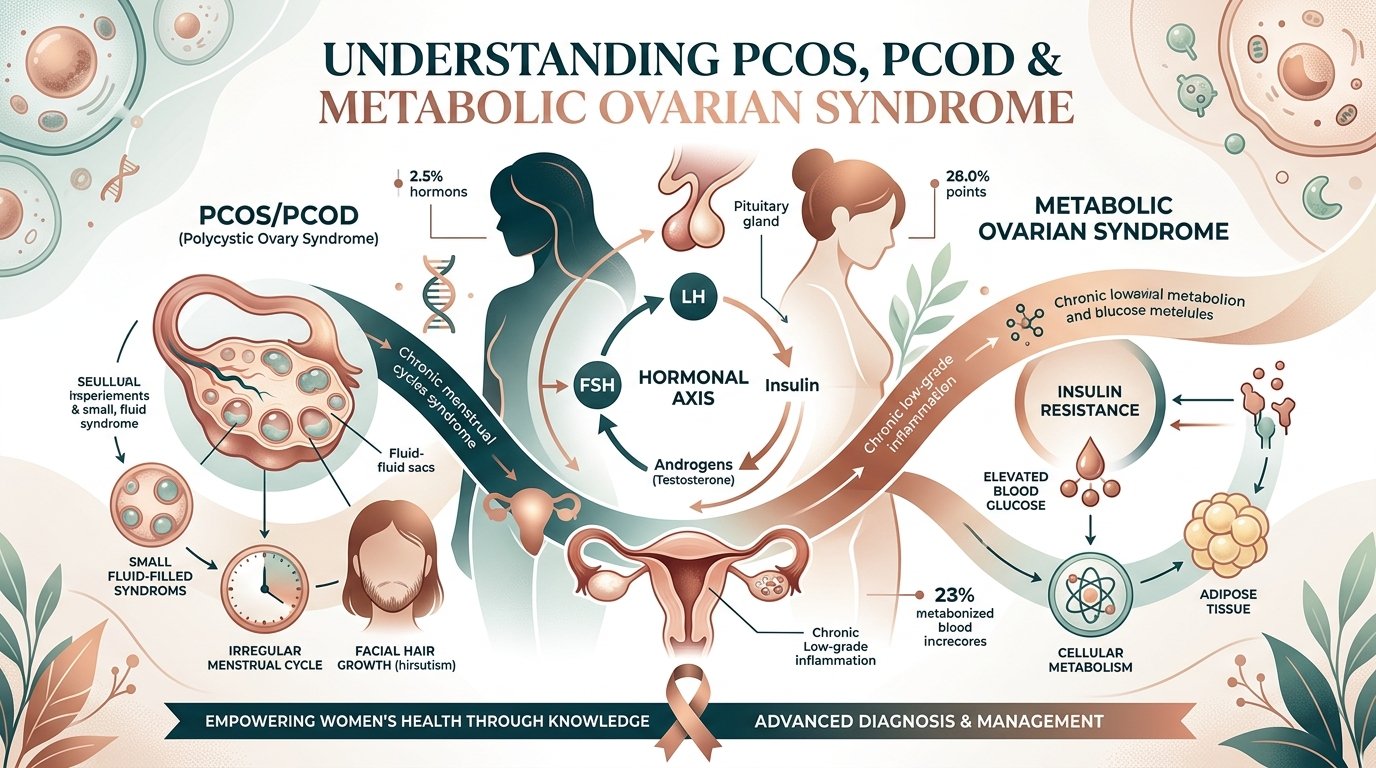
The historical term Polycystic Ovary Syndrome originated in 1935 when doctors Stein and Leventhal noticed enlarged ovaries with a “pearl necklace” ring of fluid-filled sacs on surgical examination. However, modern ultrasonography reveals that:
- They are NOT cysts: The small fluid-filled sacs seen on an ultrasound are not pathological cysts or tumours. They are simply normal, immature egg follicles that failed to mature and release an egg due to altered hormonal signals.
- You can have PCOS without “cysts”: Nearly 20% to 30% of women meeting clinical criteria for metabolic anovulation do not show classic polycystic morphology on an ultrasound scan.
- You can have polycystic ovaries without the syndrome: Up to 25% of completely healthy women have multi-follicular ovaries on ultrasound without any hormonal imbalance or period irregularity.
The name PMOS (Polycystic Metabolic Ovarian Syndrome) eliminates this diagnostic confusion by putting Metabolic at the centre of the diagnosis.
2. The Biological Engine of PMOS: How Insulin Resistance Drives It
At the physiological root of over 75% to 85% of PMOS cases is Insulin Resistance (IR). Here is the chain reaction that occurs inside the body:
- Cellular Resistance: Muscle, liver, and fat cells stop responding efficiently to normal levels of insulin, the hormone responsible for clearing glucose from your blood into cells for energy.
- Compensatory Hyperinsulinemia: To force glucose into resistant cells, the pancreas secretes increasingly high levels of insulin.
- Ovarian Androgen Overproduction: While the body’s other cells are resistant to insulin, the ovaries remain exquisitely sensitive to it. High circulating insulin directly stimulates the theca cells of the ovary to produce excessive androgens (male hormones like testosterone and DHEAS).
- Arrested Ovulation: High androgens impair the normal growth of ovarian follicles. Instead of one follicle maturing into a healthy egg for ovulation each month, multiple follicles stall in development, resulting in delayed, irregular, or skipped periods.
3. Common Clinical Symptoms of PMOS
Because PMOS is a metabolic condition, symptoms extend far beyond the menstrual cycle:
🩸 Menstrual Irregularity
Periods arriving every 45 to 90 days, erratic cycles, or total absence of periods without pregnancy.
⚖️ Stubborn Weight & Cravings
Weight accumulation around the abdomen, extreme carbohydrate cravings, and sudden fatigue crashes 1–2 hours after meals.
🪞 Androgen Signatures
Hirsutism (coarse dark hair on the chin, upper lip, chest, or abdomen), adult cystic acne along the jawline, and crown hair thinning.
🔍 Skin Markers
Acanthosis nigricans — dark, velvety pigmentation around the neck folds, armpits, or inner thighs, directly signalling high insulin.
4. How Treatment Shifts Under the PMOS Framework
Under the conventional approach, patients were often told: “Take this contraceptive pill to get a monthly bleed, and come back when you want to conceive.”
While oral contraceptive pills can temporarily manage symptoms, they do not resolve the underlying insulin resistance or metabolic driver. When the pill is stopped, symptoms frequently return with greater intensity. Under the PMOS holistic medical paradigm, treatment focuses on root-cause restoration:
A. Targeted Insulin Sensitization
- Myo-Inositol & D-Chiro-Inositol (40:1 Ratio): Clinical trials show that targeted inositol supplementation improves insulin signalling at the ovarian receptor level, restoring spontaneous ovulation and improving egg quality naturally.
- Metformin Therapy: For women with documented glucose intolerance, elevated fasting insulin, or high BMI, clinical insulin-sensitizing medication is used under strict medical supervision.
B. Evidence-Based Metabolic Nutrition
- Shifting to a low-glycemic, anti-inflammatory dietary pattern that prioritises protein and dietary fibre at every meal to stabilize blood sugar curves.
- Avoiding severe, crash starvation diets which spike stress hormones (cortisol) and exacerbate hormonal imbalance.
C. Progressive Strength & Resistance Training
Skeletal muscle is the largest consumer of glucose in the human body. Engaging in progressive strength training 3 to 4 times weekly builds muscle GLUT-4 glucose transporters, enabling your body to clear blood sugar independently of high insulin levels.
D. Specialized Infertility & Ovulation Induction Protocols
For women attempting to conceive with PMOS, modern reproductive medicine offers predictable, safe solutions:
- First-Line Ovulation Induction: Medications like Letrozole or Clomiphene Citrate to induce timely egg maturation.
- Serial Follicular Ultrasound Tracking: Monitoring follicle growth precisely inside the hospital to time intercourse or IUI accurately.
- Laparoscopic Ovarian Drilling (LOD): Minimally invasive keyhole procedure reserved for clomiphene-resistant cases to reduce androgen-producing tissue.
Frequently Asked Questions (FAQ)
Q1. Is PMOS an entirely new disease?
No. PMOS (Polycystic Metabolic Ovarian Syndrome) is the medically evolving nomenclature for what was traditionally called PCOS or PCOD. It reflects our deeper understanding that the condition is driven by metabolic and endocrine factors, rather than a disease limited to the ovaries.
Q2. Can PMOS be cured completely?
While PMOS has a genetic predisposition, it can be put into complete, long-term clinical remission. With proper metabolic regulation, women achieve regular natural menstrual cycles, clear skin, healthy weight management, and healthy natural pregnancies.
Q3. Does having PMOS mean I cannot get pregnant?
Absolutely not. PMOS is one of the most treatable causes of female subfertility. Once ovulation is restored through metabolic adjustments or mild ovulation induction medications under an experienced gynaecologist, pregnancy success rates are very high.
Q4. How is PMOS diagnosed at Verma Hospital?
At Dr. Verma Multi-Speciality Hospital in Nagpur, our diagnostic protocol includes high-resolution pelvic sonography, fasting insulin, HbA1c, AMH (Anti-Müllerian Hormone), LH/FSH ratio, and androgen profiles — all conducted under one roof with same-day reports.